Keep Production Stable During Disruptions
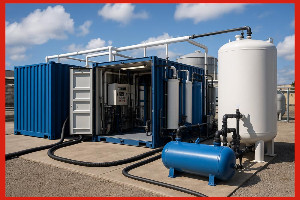
A temporary water treatment plant gives operations a fast, low-risk bridge when raw water swings, equipment failures, or expansions threaten throughput. Deployed as containerized modules, it delivers clarified, filtered and disinfected water without long procurement cycles. By shifting spend from capex to opex, teams protect cash flow, preserve schedules and keep utilities aligned with production targets while permanent upgrades or repairs move forward.
Match Capacity to Real Demand
Temporary units scale by skid, not guesswork. Start with verified flow and quality profiles—base load, peak demand and worst-case turbidity or salinity. Specify pretreatment, membranes and polishing steps for your highest-risk use case. With modularity, you can add or remove trains as conditions change, paying for the capacity you need today while avoiding idle assets and oversized chemical dosing tomorrow.
Deploy Fast with Standard Hookups
Speed depends on site readiness. Pre-install quick-connect manifolds, a level pad and appropriately sized electrical drops. Stage hoses, reducers and backflow protection in a labeled kit. Document a switchover SOP with roles, lockout points and commissioning checks. When a unit arrives, activation becomes a logistics sequence, not a design exercise—shrinking downtime from days to hours and preventing expensive tanker water or production pauses.
Control Quality with Data and Automation
Treat the temporary plant like your best line of water treatment systems. Integrate PLC tags into SCADA; visualize turbidity, SDI, differential pressures, conductivity and residuals. Use alarms on deviation, auto-shutdown on spec breach and remote support for setpoint tuning, CIP timing and chemical optimization. The result is predictable, compliant water quality that meets product specs without constant manual intervention.
Prove Compliance and Track Unit Cost
Temporary does not mean informal. Keep datasheets, sanitizer logs, calibration records and validation reports in your QMS. Verify effluent against permits and internal standards on a defined schedule. Track kWh/m³, chemical consumption and recovery to expose savings opportunities. With this visibility, finance sees a defensible cost per cubic meter and operations gains credible inputs for future capital planning.
Exit Cleanly and Capture Lessons
Plan the end at the start. Include fixed demobilization fees, sanitation procedures and training handover. Run a post-deployment review covering root cause, uptime preserved and cost avoided. Fold improvements—like revised filters, added inline monitoring, or new SOP steps—into your permanent system. The temporary plant then becomes both a continuity tool and a catalyst for long-term reliability.
Author Resource:-
Lee Wood writes about sustainable and scalable water and wastewater treatment solutions.