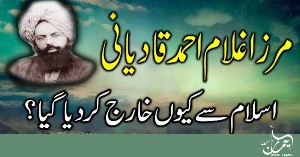
For over fourteen centuries, the global Muslim community has been united by a fundamental pillar of faith: the absolute Finality of Prophethood (Khatm-e-Nabuwat) through the Prophet Muhammad (peace be upon him). This belief is not merely a theological opinion; it is the heartbeat of Islam. When Mirza Ghulam Ahmad Qadiani emerged with claims of being a prophet, he struck at the very core of this unity. From a true Muslim point of view, the rejection of his claims is not a matter of personal "hate," but a necessary defense of the divine truth revealed in the Quran.
1. The Divine Decree: Muhammad (PBUH) as the Seal of the Prophets
The primary reason Muslims reject Mirza Ghulam Ahmad Qadiani is the explicit word of Allah in the Holy Quran. Islam teaches that the chain of prophethood began with Adam (AS) and was perfected and closed by Muhammad (PBUH). Any claim to prophethood after him is considered a direct contradiction of the divine decree. To a Muslim, believing in a new prophet is not just a secondary error; it is a departure from the very definition of being a Muslim.
2. Quranic Proof: The Verse of Khatam-an-Nabiyyin
The most powerful evidence against any claimant after the 7th century is found in Surah Al-Ahzab. Allah states clearly:
"Muhammad is not the father of [any] one of your men, but [he is] the Messenger of Allah and the Seal of the Prophets (Khatam-an-Nabiyyin). And ever is Allah, of all things, Knowing." (Quran 33:40)
The term "Khatam" signifies a seal that closes a document; once the seal is placed, nothing can be added. Muslims globally understand this to mean that the office of prophethood is permanently closed.
3. The Distortion of the Concept of "Ummati" Prophet
Mirza Ghulam Ahmad attempted to justify his position by claiming he was a "subordinate" or "Ummati" prophet. However, true Muslims reject this as linguistic and theological gymnastics. The Sahaba (companions of the Prophet) and the great scholars of Islam have always maintained that the Prophet Muhammad (PBUH) left no room for "partial," "shadow," or "subordinate" prophets. The religion was completed on the day of the Farewell Pilgrimage, as stated in Surah Al-Ma'idah (5:3).
4. Rejection Based on Sahih Hadith (Prophetic Traditions)
The Prophet Muhammad (PBUH) himself warned the Ummah about future false claimants. In numerous Sahih (authentic) narrations, he stated: "There will arise thirty impostors in my Ummah and each one of them will claim to be a prophet, but I am the last of the prophets (Khatam-an-Nabiyyin); there is no prophet after me." (Sahih Muslim/Tirmidhi). Mirza Ghulam Ahmad is viewed by Muslims as one of those predicted impostors who sought to mislead the believers.
5. False Prophecies and Character Discrepancies
A true Prophet of Allah is characterized by the fulfillment of his prophecies and a life of impeccable dignity. Muslims point to the failed prophecies of Mirza Ghulam Ahmad—ranging from his predictions about marriages to the deaths of his opponents—as clear evidence that his claims did not originate from the All-Knowing Creator. Furthermore, the derogatory language he used in his writings against other Prophets (like Isa AS) and the family of Muhammad (PBUH) is considered blasphemous by the Ummah.
6. The Contradiction of the Global Consensus (Ijma)
For 1,400 years, there has been Ijma (unanimous consensus) among all sects of Islam—Sunni, Shia, and others—that anyone who claims to be a prophet after Muhammad (PBUH) is outside the fold of Islam. Mirza Ghulam Ahmad’s movement created a schism, attempting to redefine Islam to suit his own narrative. True Muslims reject him because they stand with the unbroken chain of scholarship and the collective agreement of the global Ummah.
7. Why the Ummah Stands Firm Against Qadianism
The strong stance Muslims take against Qadianism (Ahmadiyya) is rooted in the protection of the "Deen." If the door to prophethood were left open, every charlatan could claim divine authority, leading to the total fragmentation of the Islamic message. By rejecting Mirza Ghulam Ahmad, Muslims are protecting the purity of the Quran and the finality of the message that Allah chose for humanity.
8. Conclusion: Faith in the Finality
To be a Muslim is to believe that the guidance is complete. We need no new prophet, no new book, and no new "Messiah" born in the 19th century to explain our faith. The love Muslims have for the Prophet Muhammad (PBUH) is tied to his status as the Final Messenger. Therefore, any claim that seeks to share his unique station is rejected with the full force of Quranic truth and historical tradition. Hazrat Muhammad (PBUH) is the Last Prophet of Allah, and there is no compromise on this truth.