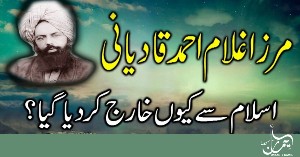
The question of finality of Prophethood is among the most firmly established principles in Islam. For over 1400 years, the Muslim Ummah — Sunni, Shia, scholars of all schools, and every generation of believers — has unanimously agreed that Prophet Muhammad ﷺ is the last and final Messenger of Allah. This belief is rooted directly in the Qur’an, the Hadith, and the Ijma’ (consensus) of the Ummah.
When Mirza Ghulam Ahmad Qadiani (founder of the Qadiani/Ahmadiyya movement) declared himself a prophet, Muslims rejected his claim because it contradicted the clear and explicit teachings of Islam. The disagreement is theological and doctrinal — not personal — and grounded purely in Islamic scripture.
Below is a detailed, evidence-based explanation.
1. The Qur’an Clearly Declares Prophet Muhammad ﷺ as the Final Prophet
The foundational verse on this matter is Surah Al-Ahzab (33:40):
“Muhammad is not the father of any of your men, but he is the Messenger of Allah and the Seal of the Prophets (Khatam an-Nabiyyin).”
This verse is decisive. The term Khatam an-Nabiyyin in Arabic means:
The last of the prophets
The final in the chain
The one who seals and completes Prophethood
All classical scholars — from Ibn Abbas, Imam Tabari, Ibn Kathir, Qurtubi, Fakhr al-Din Razi, and countless others — unanimously affirm that no prophet can come after Muhammad ﷺ.
Thus, any individual claiming prophethood after him contradicts the Qur’an.
2. Finality of Prophethood Is Reinforced by Multiple Hadith
Prophet Muhammad ﷺ himself confirmed what the Qur’an states. Some key Hadith include:
“There is no prophet after me.”
— Sahih al-Bukhari & Sahih Muslim
“The line of Messengers and Prophets has come to an end.”
— Musnad Ahmad
“I am the Last Prophet, and my mosque is the last mosque.”
— Sahih Muslim
The evidence is overwhelming. The Prophet ﷺ left no room for reinterpretation, ambiguity, or exceptions.
3. Why Muslims Reject Mirza Ghulam Ahmad’s Claim
Muslims do not reject Mirza Ghulam Ahmad due to personal feelings. The rejection is purely based on:
❌ His claim contradicts the Qur’an
❌ His claim contradicts authentic Sunnah
❌ His claim contradicts the consensus (Ijma’) of the entire Ummah
His assertion of prophethood automatically places his claim outside Islamic belief, because Islam’s foundational scripture closes the door to any prophet after Muhammad ﷺ.
Thus, Muslims consider his claim invalid, not because of hatred, but because accepting such a claim would violate the core teachings of Islam.
4. Qur’anic Proof That No New Prophet Can Appear After Muhammad ﷺ
Beyond Surah Al-Ahzab (33:40), many verses indirectly prove the finality of prophethood:
A. Surah Al-Maidah (5:3)
“Today I have perfected your religion for you, completed My favor upon you…”
A complete religion needs no new prophet, revelation, or reformer.
B. Surah Al-Anbiya (21:107)
“We have sent you (O Muhammad) as a mercy to all the worlds.”
A universal, timeless messenger for all humanity leaves no space for future prophets.
C. Surah Saba (34:28)
“We have sent you to all of mankind as a bearer of good news and a warner.”
If the Prophet ﷺ was sent to all humanity, what role could a later prophet play?
D. Surah Al-Fath (48:28)
Islam’s message is described as final, complete, and victorious — not awaiting another prophet.
Collectively, these verses make the finality of prophethood unshakeable.
5. Scholarly Consensus Against Mirza Ghulam Ahmad’s Claims
From the earliest scholars to present-day institutions — Al-Azhar University, Darul Uloom Deoband, Madinah University, scholars of Mecca and Medina, and all recognized Islamic bodies — all agree:
Anyone claiming prophethood after Prophet Muhammad ﷺ contradicts Islam.
This consensus has never been disputed in 14 centuries.
Qadiani claims were rejected on this same basis.
6. The Danger of Claiming Prophethood After Muhammad ﷺ
When someone claims to be a prophet after the final Messenger, several theological problems arise:
It implies the Qur’an is incomplete
It implies the Prophet Muhammad’s mission was insufficient
It suggests Allah’s final religion needs updates
It introduces divisions and confusion in the Ummah
Islam protects believers from such misguidance by closing the door to future prophets.
Thus, the Qadiani claim is considered a distortion of Islamic core doctrine.
7. Conclusion: The Qur’an Leaves No Room for a Prophet After Muhammad ﷺ
Mirza Ghulam Ahmad Qadiani’s declaration of prophethood is rejected by Muslims not out of hostility, but because it directly opposes the Qur'an, the Sunnah, and the unanimous consensus of scholars.
To summarize the Islamic position:
The Qur’an declares Muhammad ﷺ as the Seal of the Prophets
Authentic Hadith repeatedly confirm no prophet will come after him
Islamic scholarship for 1400 years agrees on this principle
Any claim to prophethood after him is considered false by Islamic doctrine
Therefore, Muslims firmly maintain that: